Is Google using AI summaries in Discover?
Filed under Discover & News · Markdown version

Why it matters
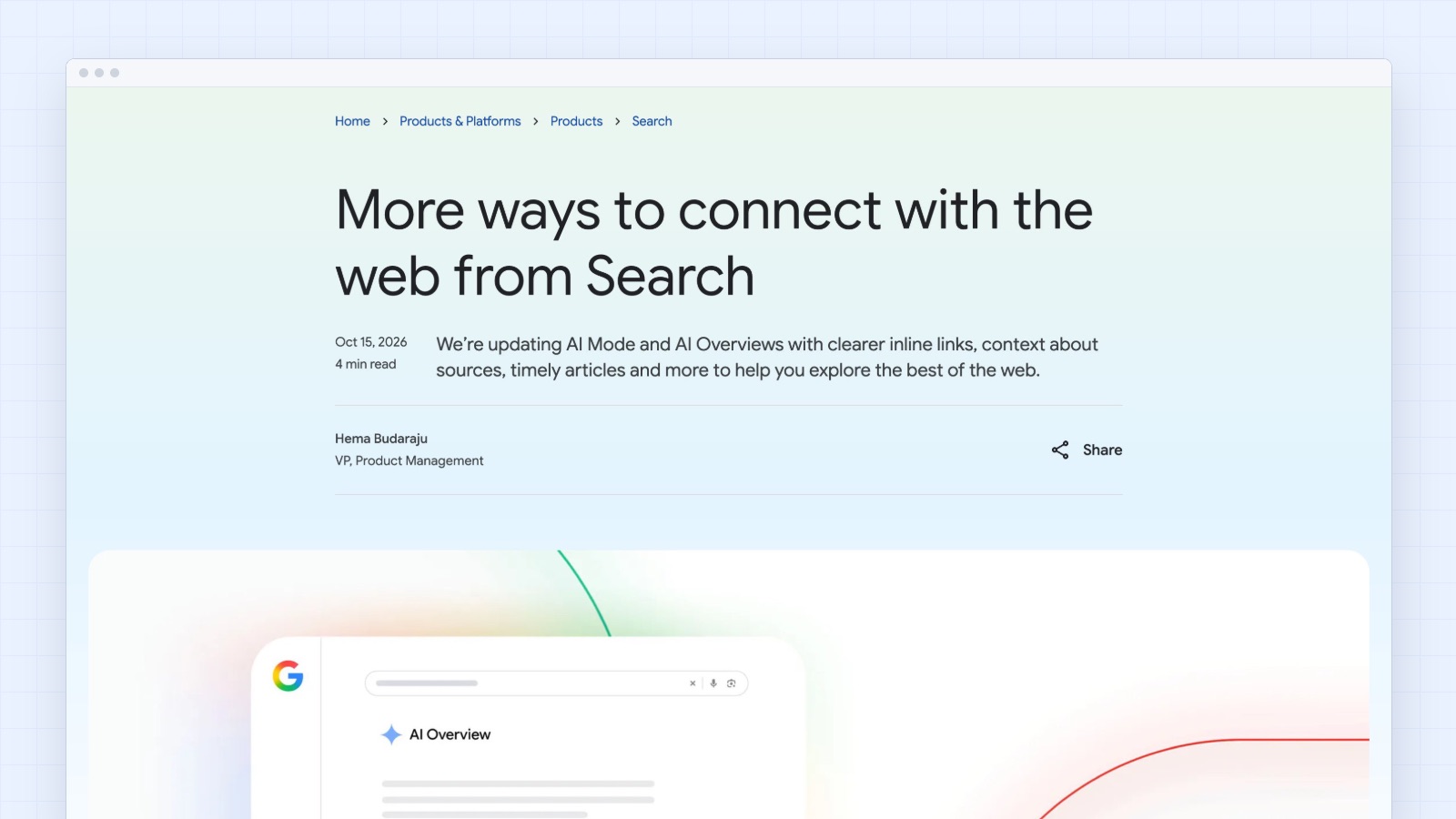
- Google is using AI-generated summaries in Discover; it announced expandable previews of trending topics on 13 October 2025.[1]
- Google’s 2026 publisher control covers generative AI features in Discover and does not change ranking in other Search results.[7]
- Chartbeat reported a 34.3% Discover decline for July 2025–July 2026, but the figure does not prove that AI summaries caused the decline.[13][14]
- Define Media Group reported Discover growth in separate publisher samples, including 168% growth for breaking-news traffic in a 15-brand analysis.[16]
- Google News is a separate paid AI pilot with more than 400 participating publications, and its reported participation count is not a publisher traffic result.[17]
In this story (7 sections)
Yes. As of 17 November 2026, Google is using AI-generated summaries in Discover: the company announced expandable AI previews of trending topics on 13 October 2025, while publisher controls and Discover-specific visibility reporting rolled out globally in 2026.[1][2] The available evidence does not establish how much of any publisher traffic change is caused specifically by those summaries.[3]
What happened
Google first confirmed that Discover AI summaries were available in the United States on iOS and Android on 15 July 2025.[4] The summaries combined publisher logos with an AI-generated preview and links to related coverage; Google warned that the summaries could contain mistakes.[4][3]
On 13 October 2025, Google described the feature as expandable AI-powered previews of trending topics, available at that time in the United States, South Korea and India.[1] Google said the previews were intended to help users catch up on stories and included links for further reading, but it did not publish a traffic lift, test size or publisher click-through result.[5]
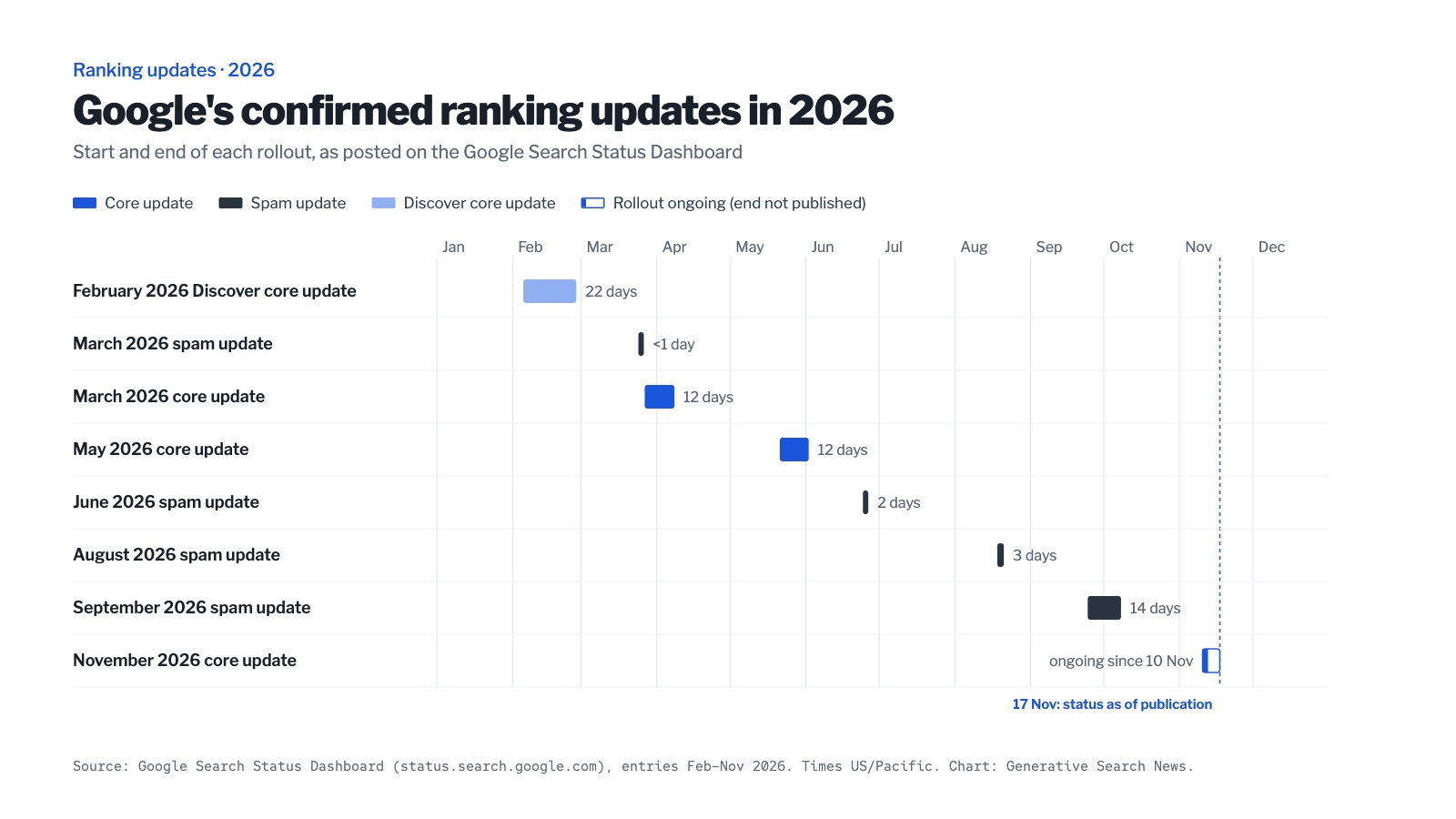
Discover continued to change during 2026. Google announced a Discover-specific core update on 5 February, new topic-personalization controls on 20 August, and a reported “Dive deeper” test in September that opened topic overviews beginning with videos.[5][6]
These changes are separate from the existence of AI summaries. A ranking update, a personalization control, additional creator content and an AI summary can all affect the feed, but the cited evidence does not isolate their individual effects.[7][8]
Why it matters for publishers
AI summaries can change how users encounter publisher content before they open an article. Google’s Discover reporting measures impressions for links to a site within generative AI features, but the documented report does not include clicks or click-through rate.[9][5]
That distinction matters because an impression shows visibility, not a visit. A publisher may appear in a summary or source group without the available reporting establishing how many users clicked through.[10][8]
Google’s 2026 publisher control covers generative AI features in Discover, as well as AI Overviews and AI Mode in Search.[5][11] Google says that opting out of the covered generative AI features does not change a site’s eligibility or ranking in other Search results.[5]
The control also has a specific scope. Excluded content cannot appear in the covered features or be used as input for their answers or previews, while Google’s separate Google-Extended setting governs certain AI training uses.[3][12]
For publishers, the decision is therefore not simply whether to be “in Google” or “out of Google.” The relevant questions are whether the site appears in AI presentations, whether it receives direct visits, whether the visibility is commercially valuable and whether the available data is sufficient to compare those outcomes.[3][5]
What is the evidence of a Discover traffic impact?
The broadest cited 2026 evidence reports a decline, but it does not attribute that decline causally to AI summaries. Chartbeat’s Publisher Playbook reports a 34.3% Discover decline for July 2025 through July 2026 in its network data.[13][14]
Chartbeat’s earlier comparison reported a 6.6% decline for July 2024 through July 2025, while separate reporting on Chartbeat data found Discover pageviews down 15% from December 2024 to December 2025.[13] These figures use different periods and should not be treated as one continuous measurement.[3]
Other publisher samples show growth. Define Media Group reported 30% Discover growth for a 64-publisher cohort covering November 2024 to February 2026, even as Web Search declined 43% and total portfolio clicks still fell.[15] Define separately reported that Discover breaking-news traffic increased 168% in a 15-brand analysis compared with November 2024.[16][15]
The samples are not directly comparable. Chartbeat reports a broad network result, while Define’s figures cover particular publisher groups and, in one case, a specific breaking-news category.[14]
The defensible conclusion is that Discover outcomes were uneven in the cited data. Some publisher cohorts experienced declines, while selected breaking-news and publisher groups recorded growth.[3]
What we know and what is not confirmed
Confirmed
- Google announced expandable AI previews for trending topics in Discover on 13 October 2025.[1]
- Google had already confirmed a U.S. Discover AI-summary launch on 15 July 2025.[4]
- Google’s publisher control covers generative AI features in Discover.[5][7]
- The control reached websites worldwide by 31 August 2026.[7][5]
- Search Console’s Discover generative AI report documents impressions of visible links.[6][9]
- Google announced a separate Google News AI pilot involving more than 400 publications on 15 October 2026.[17]
- Chartbeat reported a 34.3% Discover decline for July 2025–July 2026 in its network data.[13]
- Define Media Group reported Discover growth in its publisher samples.[16][15]
Not confirmed
- The percentage of Discover traffic lost specifically because of AI summaries is not published in the cited evidence.[12]
- Discover AI-summary clicks and CTR are not included in the documented generative AI performance report metrics.[9]
- A measured traffic outcome from a publisher opting out of Discover generative AI features is not published in the cited publisher reporting.[5]
- The September 2026 “Dive deeper” feature is not confirmed as a universal launch; the cited report describes it as a test.[6]
- Google News pilot payments, publisher-specific revenue effects and controlled referral results are not published in the cited October update.[2][8]
- The academic estimate of approximately 15% lower traffic applies to English Wikipedia following exposure to Search AI Overviews, not to Discover.[2]
The academic evidence therefore provides context rather than a Discover answer. A 2026 arXiv study used a difference-in-differences design across 161,382 matched article-language pairs and estimated an approximately 15% reduction in English Wikipedia traffic associated with AI Overview exposure.[2] The study examined Google Search AI Overviews and Wikipedia, not Discover, Google News or the general publisher market.[2][12]
What changed in Discover and Google News during 2026?
| Date | Surface | Confirmed development | Publisher significance |
|---|---|---|---|
| 5 February 2026 | Discover | Google announced a Discover-specific core update for English-language users in the United States.[18][15] | Ranking changes occurred during the period in which traffic effects were measured. |
| 20 August 2026 | Discover, Search and News | Google announced controls for requesting more or less of topics or links through the three-dot menu.[19] | Personalization changed independently of AI-summary reporting. |
| 31 August 2026 | Discover and Search | Google said its generative AI controls and insights had reached websites worldwide.[5] | Publishers gained a documented inclusion control for covered AI features. |
| September 2026 | Discover | Search Engine Journal reported a video-first “Dive deeper” topic-overview test.[6] | The feature remained a reported test rather than a confirmed universal rollout. |
| 15 October 2026 | Google News | Google reported more than 400 participating publications in its News AI pilot.[17] | The separate pilot expanded through licensed article overviews and audio briefings. |
| 17 November 2026 | Discover and Google News | The available evidence still did not provide a controlled Discover traffic estimate attributable to AI summaries.[12] | Publisher decisions remained dependent on incomplete click and referral data. |
How is Google News different from Discover?
Google News and Discover should not be treated as the same AI product. Google announced a global Google News pilot on 10 December 2025 involving AI-powered article overviews and audio briefings on participating publication pages.[20]
The News pilot includes attribution and links, and Google’s October 2026 update said that more than 400 publications were participating.[17] Google also described the program as a licensing arrangement that pays participating publications for the delivery and use of enhanced content in AI features.[17]
The October update named partners including Axios, CNN, the Financial Times and Forbes, alongside local publishers and groups.[17] Participation and payment do not, however, establish a measured increase or decrease in visits for any participating publisher.[21]
The cited evidence does not extend the Google News licensing terms to Discover. It also does not provide a controlled comparison of referral traffic from Google News AI overviews or audio briefings.[20][19]
A useful distinction is:
- Discover AI summaries: summaries of trending topics in the Discover experience, covered by Google’s generative AI control and Discover visibility report.[4]
- Google News AI pilot: licensed publisher content used for article overviews and audio briefings on Google News.[17][20]
- Search AI Overviews: search-result summaries, including the feature studied in the Wikipedia traffic paper.[2]
These surfaces may all use generative AI, but the cited sources do not establish a shared ranking system, shared commercial terms or shared traffic effect.[5][2]
What should publishers measure now?
Publishers should separate four outcomes rather than treating them as interchangeable:
- Visibility: whether a publisher’s link or content appears in a Discover generative AI feature.[5]
- Impressions: whether the visible link scrolls into view in the documented Discover report.[9]
- Clicks: direct visits from the feature, which are not included in the documented metric set.[2][5]
- Business results: conversions, subscriptions, advertising value or revenue, none of which are supplied by the cited Discover report.[20]
Google’s report can help publishers observe visibility and impression changes, but the cited documentation does not provide the referral data needed to calculate Discover AI-summary CTR.[5]
Publisher accounts reported in November 2026 show why decisions remain unsettled. Digiday reported that Trusted Reviews/Candr Media was waiting for click data before using the controls, while The Economist Group was evaluating the issue and the Daily Mail was discussing how to approach it.[5]
Those accounts do not document a mass publisher withdrawal or a measured success from remaining included.[2] They show that the control exists while the evidence needed to assess its traffic consequences remains incomplete.[5]
The reported Reach case illustrates a related presentation concern. Press Gazette described a Discover summary involving 14 publishers in which People was the main initially clickable publisher link, while Google said users could open a cluster of related stories to see the full list.[8]
That case supports a concern about source presentation and interaction depth, but it does not provide a controlled click-through loss for the affected publishers.[12]
Background: how Discover AI summaries differ from ordinary links
Ordinary Discover recommendations present links to content selected for the user’s feed. In the AI-summary format described by Google, a trending topic can receive an expandable preview that synthesizes information and provides supporting links.
The preview is not equivalent to a publisher article, and its appearance does not prove that a user visited any cited source. Google’s reporting currently documents impressions of visible links, while the cited documentation does not publish clicks or CTR for the Discover generative AI report.[5]
Google’s 2026 control lets sites exclude themselves from covered generative AI features without changing their ranking in other Search results.[5][7] This control is separate from Google-Extended training controls.
Frequently asked questions
Does Google Discover use AI summaries in 2026?
Yes. Google announced expandable AI-powered previews of trending topics in Discover on 13 October 2025, after confirming a U.S. launch in July 2025.[4] The cited evidence confirms the feature’s existence but does not provide a 2026-wide traffic impact estimate.
Do Discover AI summaries reduce publisher traffic?
The cited evidence does not prove that AI summaries caused a specific reduction in publisher traffic. Chartbeat reported a 34.3% Discover decline for July 2025–July 2026, while Define Media Group reported growth in different publisher samples and content categories.[13]
Can publishers opt out of Google Discover AI summaries?
Google’s generative AI control covers AI features in Discover and had reached websites worldwide by 31 August 2026.[7][5] Google says opting out of the covered features does not change ranking or inclusion in other Search results.[5]
Does Search Console show clicks from Discover AI summaries?
The documented Discover generative AI report measures impressions of visible links to a site.[9] Clicks and CTR are not included in the documented metric set, so the report cannot by itself quantify referral traffic from the summaries.[5][12]
Is Google News using the same AI summaries as Discover?
No shared system or shared commercial arrangement is established by the cited evidence. Google News has a separate pilot for article overviews and audio briefings, with more than 400 participating publications reported on 15 October 2026.[17]
Sources
- [1]New AI features connect you with web content in Search and Discover — blog.google
- [2]Impact of AI Search Summaries on Website Traffic: Evidence from Google AI Overviews and Wikipedia — arxiv.org
- [3]INMA: Google Search, Discover, AI, and YouTube redraw the news traffic map — web.inma.org
- [4]Google Discover adds AI summaries, threatening publishers with further traffic declines | TechCrunch — techcrunch.com
- [5]As publishers await click data, Google’s AI visibility push complicates the opt-out decision - Digiday — digiday.com
- [6]Google Discover Test Adds Topic Overviews, Starting With Videos — searchenginejournal.com
- [7]New opportunities, control and insights for website owners — blog.google
- [8]Google Discover grouping publishers together below AI summary - Press Gazette — pressgazette.co.uk
- [9]Generative AI performance report (Discover) - Search Console Help — support.google.com
- [10]Google Discover is adding AI between you and the reporting it recommends — androidauthority.com
- [11]CMA secures fairer deal for publishers and improves Google search services in UK - GOV.UK — gov.uk
- [12]A search changer: auditing Google’s AI overviews interface in political and news search - ScienceDirect — sciencedirect.com
- [13][FINAL] Q3 2026 Reports — lp.chartbeat.com
- [14]Google Search Decline Steepened To 40% YoY For Publishers — searchenginejournal.com
- [15]BREAKING! News Thrives in the Age of AI - Define Media Group — definemg.com
- [16]Breaking news Google referrals doubled to US publishers in a year - Press Gazette — pressgazette.co.uk
- [17]400 publications are now partnering with us on our News AI pilot program. — blog.google
- [18]Google's February 2026 Discover Core Update — developers.google.com
- [19]Personalize what you see on Google Search, News, Discover — blog.google
- [20]New Google web ecosystem tools and partnerships — blog.google
- [21]AI Overviews reduce the search traffic reaching publishers - Digital Content Next — digitalcontentnext.org
Summarize with ChatGPTClaudePerplexity